Keep your eye
on one portion.
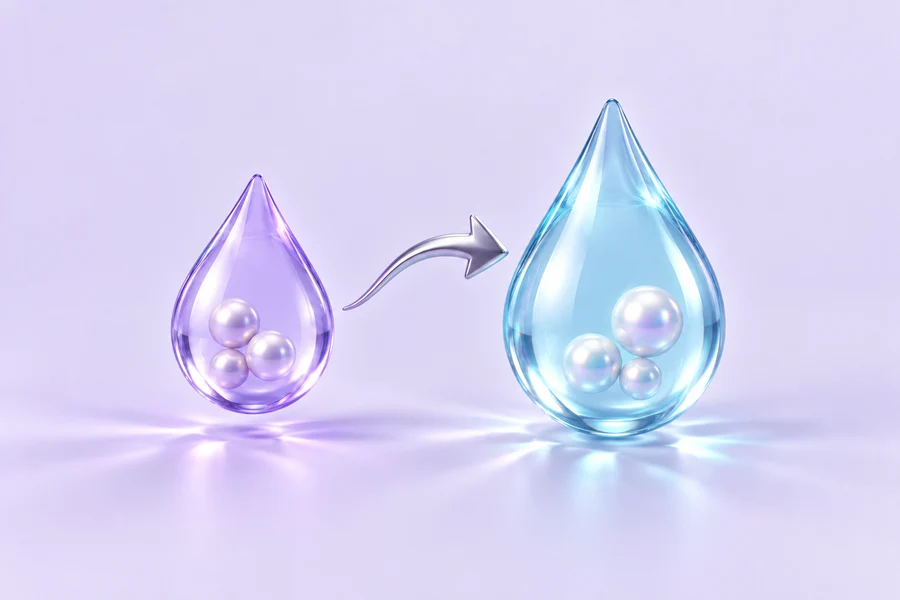
Imagine 12 dots evenly distributed through a liquid. Keep all 12 dots, then spread them through two or three times the volume. Select a volume to compare.
At twice the volume, an equal-sized portion contains half as many dots. At three times the volume, it contains one-third. None of the dots disappeared.
The relationship
in one line.
For a fixed amount, increasing the volume lowers concentration. Decreasing the volume raises it. “More concentrated” describes a ratio; it does not mean better quality, greater purity or a more appropriate amount.
This visual changes an abstract volume. It is not advice to add liquid to a product. Real preparation depends on product-specific instructions and qualified guidance.
Same marking.
Not necessarily the same mass.
A marking on a U-100 syringe corresponds to volume. If two solutions have different concentrations, the same marking represents different masses of material.
That is why copying a screenshot’s result can miss essential context. The calculation depends on the actual inputs and their units, not only the final number. Read how mg, mcg, mL and units connect.
Conversely, holding the entered mass fixed while lowering concentration means the calculated volume increases. A calculator can show that arithmetic; it cannot establish whether the entered amount is appropriate.
Use your inputs.
See the working.
The free peptide calculator takes a vial amount, water volume and an amount from your own instructions. It shows concentration, calculated volume and U-100 syringe units together.
Written by Dosii · September 28, 2026. The dot diagram assumes an evenly distributed amount. It is a conceptual arithmetic model, not a molecular simulation or product instruction.
See the calculation notes for formulas and rounding conventions, and NIST’s metric prefix reference for unit notation.